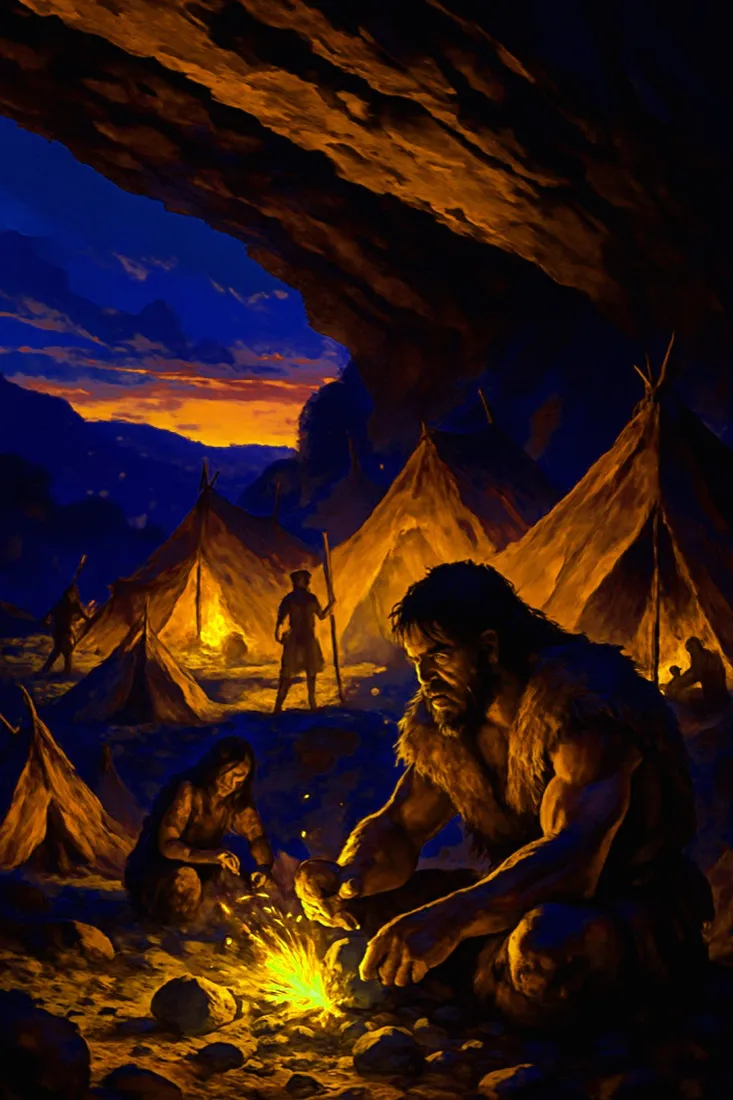
Most city builders treat your citizens as numbers. Stonies treats them as a tribe. You play as a benevolent deity watching over men, women and children at the very start of human history, and the game wants you to care about who is doing what. Someone gathers berries, someone hunts, someone learns to make fire. The camp grows because its people grow.
That focus makes Stonies feel quite unlike the civilisation games above it. There is no grand map, no famous leaders, no landmark of the ages. Instead there is a clearing, some huts and a lot of small tasks. Our diary covered several weeks of short visits, and the tribe became oddly endearing by the end.
Berries, mushrooms and the first hunts
Survival comes first. Your Stonies gather berries and mushrooms and go hunting, and the official description lists reindeer, agile rabbits and fearsome wild boar among the quarry. Food keeps the tribe going, and the materials from hunting feed the next stage: the game mentions using sinews from slain animals to make new tools.
This gives the early hours a satisfying logic. Everything you collect has a use, and you can see how one activity leads to another. It is a smaller loop than the factory chains of other builders, but it is honest about what life at the dawn of history might have looked like, and that honesty is part of the charm.
Teaching fire, spears and fishing rods
Knowledge is the real currency. You teach the tribe to make fire and to craft tools and weapons, and the game names carving stones, spears and fishing rods among them. Each new skill opens new activities, which in turn open new materials. Progress through the eras of human history comes as the Stonies’ knowledge increases.
It is a slow climb, and the game makes no apology for that. Some players will find the pace frustrating; we found it suited the theme. When the tribe finally learns something new, it feels earned in a way a click on a research tree rarely does, because you have watched the effort that went into it.
Families, huts and a widening camp
Stonies is unusually interested in family life. The official description talks about matchmaking to produce babies and watching the children grow until they can contribute to the tribe. It is handled lightly and cheerfully, and it gives the population a sense of continuity: these are not interchangeable workers but members of a growing community.
As the tribe expands, you encourage the construction of huts and establish religious sites, and the camp spreads across its clearing. There are plenty of customisation options for arranging it. The building side is modest compared with the big city games, but it is enough to give the settlement a recognisable shape that is clearly yours.
Where the slow pace helps and hurts
Stonies scores lowest on our sense-of-progress criterion, and that is a deliberate trade. The game is about small steps and individual people, so big leaps are rare. For a free player the pace feels fair, because there is no obvious wall, only a gentle incline. Tasks and missions keep you pointed at the next sensible goal.
Session rhythm is good. Most visits involve checking what each Stonie is doing, reassigning the idle ones and collecting what has been gathered or crafted. It fits a lunch break or a commute well, and the mobile app helps with that. Longer sessions are mostly about planning the next skill or reorganising the camp.
Stonies: laying the first stones
- Keep every Stonie busy; an idle tribe member is the easiest early loss to avoid.
- Prioritise food gathering until supplies are stable, then start hunting more seriously.
- Teach fire and basic tools early, since nearly every later activity depends on them.
- Build huts as soon as the tribe grows so new families have somewhere to live.
- Follow the missions closely; they reveal which skill or building matters next.
What we love
- Individual tribe members give the settlement a personal, human feel
- Gathering, hunting and crafting fit together in a clear survival logic
- Learning new skills feels earned rather than simply purchased
- Cheerful cartoon style suits the gentle Stone Age setting
What grates
- Progress is slow, and big leaps forward are rare
- Lacks the grand scale fans of civilisation games may want
- Micromanaging individual tasks can become repetitive over long stretches
The planner Stonies rewards
Players who enjoy caring for a small community more than building an empire, and who are happy with a slow, steady climb. It suits short regular visits, and its family and survival themes make it a warm alternative to the strategy-heavy games higher up the shelf.
Stonies: the finished plan
Stonies is the most personal builder on Oakhollowarcade. Its tribe of individuals, its survival chores and its slow climb through knowledge give it a character the bigger games cannot match. It is too slow to rank higher, and its scale is modest, but if you want to nurture rather than conquer, it offers something genuinely different.