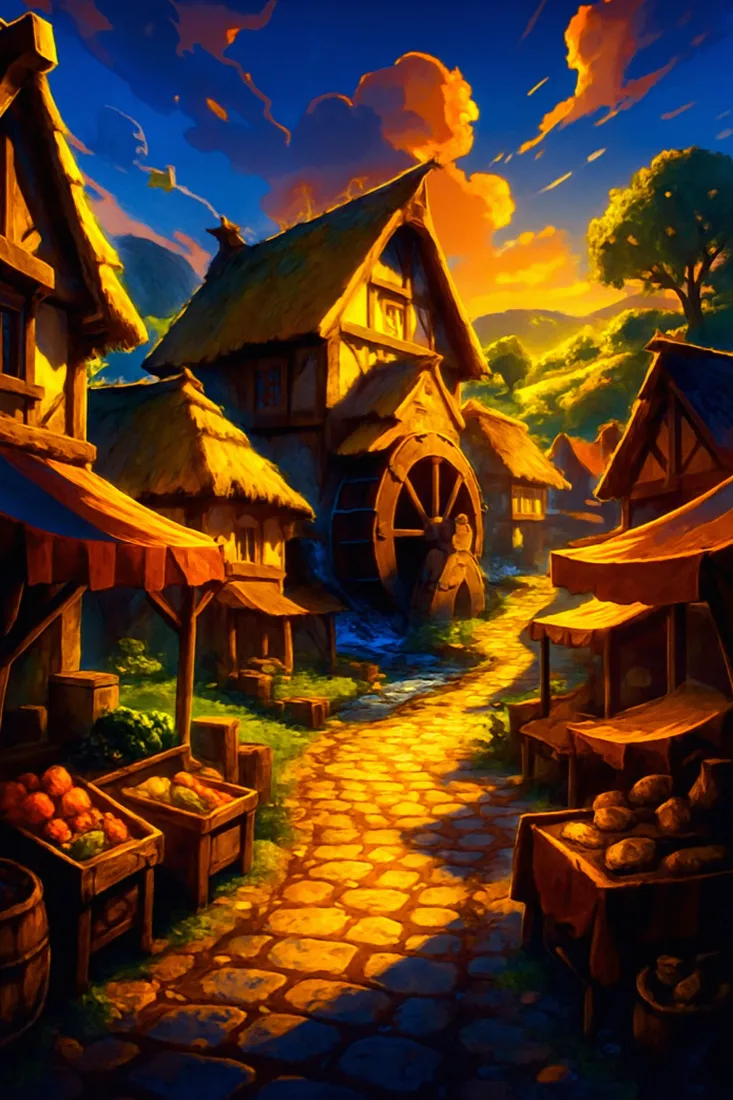
Elvenar asks one big question before anything else: elves or humans? The official description is short and accurate. Elves command powerful magic that shows in their creatures and their buildings; humans lean on medieval weaponry and stout stone. The choice sets the visual identity of your whole city, and since you will be looking at that city for months, it is worth a moment’s thought.
From there, the loop is familiar to anyone who has played a builder: residences, workshops, a main hall at the centre, and a research tree overhead. What makes Elvenar different is how much it cares about the look of things. Almost every building can be upgraded several times and changes visually as it improves. Over a few weeks our town went from a modest clearing to something we wanted to screenshot.
Elves or humans, and why it matters for months
The race choice is mostly about atmosphere, but atmosphere is the point here. Elven cities feel airy and organic, with curving lines and soft colours. Human cities are sturdier and more like a storybook market town. Both play to the same core rhythm of housing, producing and researching, so you are choosing the world you want to live in rather than a difficulty setting.
We ran one city of each across our diary period. The elven town was the more pleasant to look at, the human one slightly easier to read at a glance. Neither felt weaker. If you are unsure, pick whichever screenshot you would rather stare at on a grey Tuesday in February; that is the honest test.
Two hundred technologies and a patient tree
The research tree is large, with more than two hundred improvements listed on the official page. It moves steadily rather than dramatically: each step unlocks a building, an upgrade or a new possibility for your town, and the next one is rarely far away. That makes Elvenar easy to come back to after a busy week, because there is always one clear next step.
Research also drives the economy. As you unlock workshops and manufacture goods, you will find yourself short of some things and swimming in others, and trading surpluses becomes part of the daily rhythm. It is an economy you can understand, which is rarer than it should be in this genre, and it rewards a bit of forethought about what to build next.
The world map and the relics
Beyond the city walls sits a world map where you take on quests and explore the land around your home. Exploring reveals new areas and challenges, and the game’s relic system lets you pick up rare relics that boost production back in town. It is a tidy loop: venture out, bring something useful back, build with it.
The map never dominates the experience. You can treat it as a pleasant side road, handled in a few minutes, and spend most of your time on the city itself. Players who want armies and conquest will find it light; players who want a reason to look beyond their own streets will find it just enough.
A builder that respects a short evening
Elvenar is the steadiest performer on our scorecard, with no criterion falling below a solid mark. It is fair to a free player because its pace is predictable; you learn what each day will give you and plan accordingly. The optional premium currency hurries construction but does not unlock the heart of the game.
Sessions are naturally short. Collect, set new production, nudge the research along, perhaps move a residence to make room for an upgrade, and you are done. The longer evenings come when you decide to redesign a district, and those turned out to be some of our favourite hours on the whole shelf. Few games make shuffling buildings around this enjoyable.
Elvenar: laying the first stones
- Pick your race by the look you prefer; both play the same core loop and neither is weaker.
- Upgrade residences and workshops early rather than building many; upgraded buildings use space far better.
- Leave room around the main hall, because it grows and the city plan follows it.
- Take a few world map quests to collect relics and learn how they feed production at home.
- Plan your next three research steps so you always know which building is coming next.
What we love
- Buildings visibly transform as they level, making progress something you can see
- The calmest, most readable economy among the six games we tested
- A huge research tree that always offers a clear next step
- Rearranging the city is a genuine pleasure rather than a chore
What grates
- Players hungry for warfare will find the world map rather thin
- Space gets tight, and expanding the city takes patience
- The early hours are slow until the economy widens out
The planner Elvenar rewards
Anyone who enjoys a beautiful town more than a conquered map. If your favourite part of a builder is the moment you zoom out and admire the streets, Elvenar is made for you. It suits busy people too, because its rhythm forgives a missed day.
Elvenar: the finished plan
Elvenar does not have the historical sweep of Forge of Empires, but it is the most balanced game on Oakhollowarcade, and the one we most often opened just to look at. It is fair, readable and lovely, with a research tree deep enough to last. Choose it if you want a city that grows prettier every week and a game that never shouts at you.